Why Music Education Has Needed Better Data and Analytics for DECADES
One of the biggest challenges in music education is that success can feel extremely difficult to quantify.
Unlike many academic subjects, music performance is deeply artistic, expressive, and complex.
Even when focusing specifically on measurable skills like:
- pitch accuracy
- rhythm accuracy
- sight-reading fluency
- musical memory
students are often surprisingly unaware of how they are actually performing.
Some students become overly critical of themselves despite performing very well, while others may struggle significantly without fully realizing where their weaknesses are.
And for any busy choir teacher or instrumental director, the challenge becomes even more difficult.
Because while it is theoretically possible to sit down and carefully assess every individual rhythm and pitch performance from every student… there simply is not enough time.
Especially in ensembles with 40, 60, or sometimes well over 100 students.
That is one of the biggest reasons we built the new Analytics and Data Dashboard inside SightReadQuest.
Why Traditional Music Assessment Often Falls Short
For decades, music teachers have relied heavily on observation, intuition, rehearsal listening, occasional playing tests, and participation grades.
And while experienced music educators develop incredible instincts over time, there has still been one major problem: reliable music performance data has been incredibly difficult to collect consistently.
As a result:
- struggling students can easily go unnoticed
- growth can be highly difficult to measure
- specific weaknesses can remain hidden
- rehearsal time can become inefficient
- students may not fully understand their own progress
That creates real frustration for both teachers and students.
A New Way to Measure Music Literacy Growth
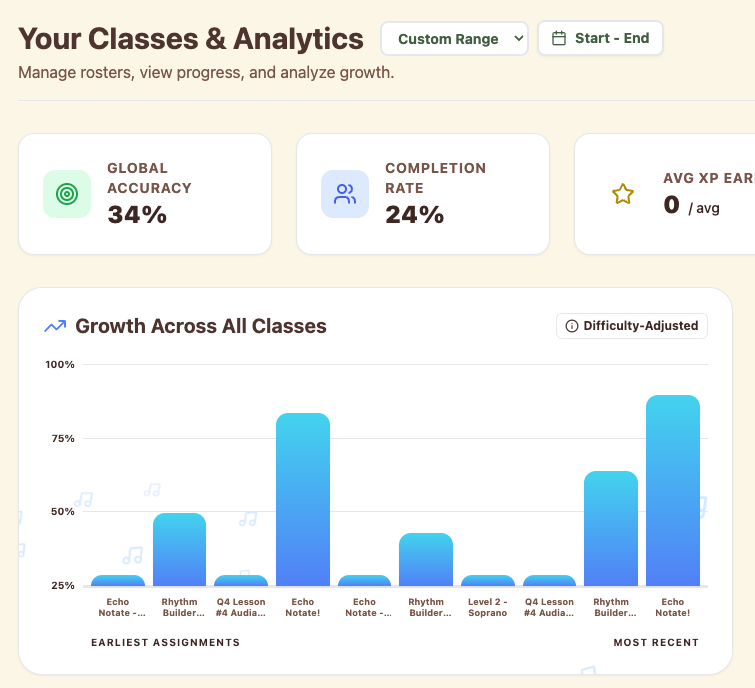
The new SightReadQuest Analytics Dashboard gives teachers detailed, real-time insights into student musical growth.
Teachers can now view analytics across:
- individual students
- classes
- sections
- grade levels
- entire ensembles
This allows teachers to move beyond vague assumptions and begin seeing measurable trends in rhythm accuracy, pitch accuracy, assignment completion, progress over time, and overall music literacy development.
For many music educators, this completely changes the entire assessment process.

Why Students Often Misunderstand Their Own Progress
One of the most interesting realities in music education is that students often judge themselves inaccurately.
Strong musicians frequently focus only on mistakes, missed notes, rhythmic errors, and imperfections. Meanwhile, struggling students may not realize how close they actually are to success.
Without meaningful feedback, both groups can quickly lose motivation.
That is where visual analytics become extremely powerful. When students can actually SEE their improvement over time, increased accuracy, completed goals, and measurable growth, their mindset begins to shift.
Progress becomes visible. And visible progress is motivating.
Real-Time Data Helps Teachers Teach More Efficiently
One of the most practical benefits of the analytics dashboard is the ability to identify specific weaknesses quickly.
Teachers can now see exactly which rhythm concepts students struggle with, which pitch patterns are causing problems, and identify class-wide or section-specific challenges.
This allows rehearsal time to become far more intentional. Instead of reviewing concepts students already understand, teachers can focus directly on:
- weak rhythmic patterns
- specific intervals
- literacy gaps
- struggling sections
- targeted reinforcement
That can dramatically improve rehearsal efficiency.
Why This Changes Differentiation in Music Education
Differentiation has always been one of the hardest parts of ensemble teaching.
Every ensemble contains students at vastly different literacy levels, confidence levels, processing speeds, and musical backgrounds. But traditional ensemble settings often make individualized assessment difficult.
The new SightReadQuest dashboard allows teachers to zoom all the way down to individual student progress.
This means teachers can quickly identify hidden struggling students, recognize students ready for more advanced challenges, and support inconsistent performers with targeted, data-driven insights.
The “Aha” Moment for Music Teachers
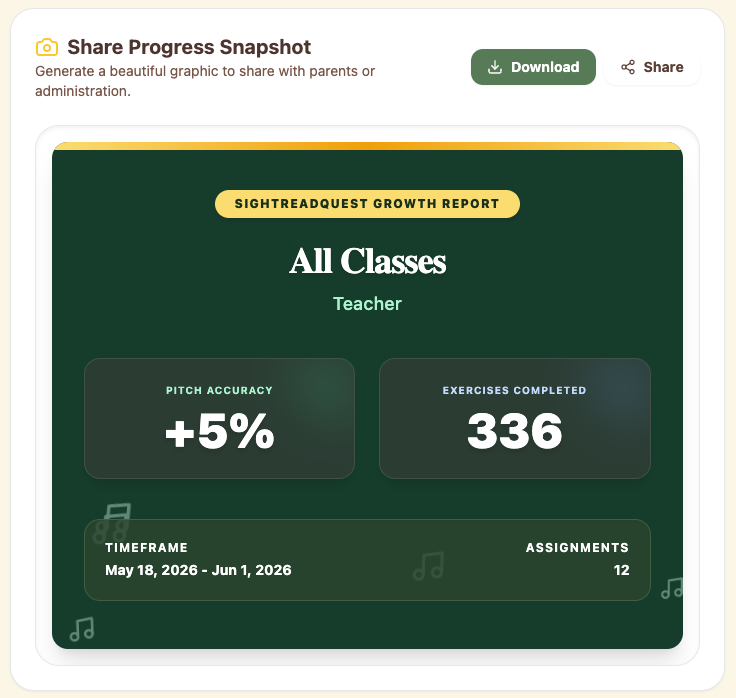
One of the biggest “aha” moments happens when teachers begin sharing analytics directly with students.
Over the course of weeks, months, or even an entire school year, students often forget how much they have grown. But when they see measurable progress, improved scores, and consistent growth trends, something powerful happens.
Students begin viewing improvement as highly achievable. That changes motivation dramatically.
Healthy Competition Can Be Extremely Motivating
For a long time, athletics have had a monopoly on visible competition and measurable progress.
Students in sports constantly see statistics, rankings, performance metrics, and scoreboards. Music students rarely experience this same type of visible growth tracking.
But positive competition in the arts can be incredibly motivating when approached correctly. The new analytics dashboard allows students to see class averages, personal improvement, and ensemble growth trends.
This encourages students to become deeply invested in their own growth, their section’s success, and their ensemble’s improvement. Instead of simply “getting through the concert,” students begin striving toward genuine musical excellence.
Why Data Matters in Music Education
Data should never replace artistry. But meaningful feedback can absolutely strengthen it.
The goal of analytics is not to reduce music into numbers. The goal is to reveal growth, identify needs, motivate students, and strengthen literacy.
When used correctly, data becomes a tool for deeper musicianship rather than shallow assessment.
Frequently Asked Questions About Music Education Analytics
What can teachers track inside the SightReadQuest Analytics Dashboard?
Teachers can view rhythm accuracy, pitch accuracy, assignment completion, class summaries, section trends, and individual student growth over time.
Why are analytics useful in music education?
Analytics help teachers identify struggling students, target instruction more efficiently, measure growth over time, and motivate students with visible progress.
Can students see their own progress?
Yes. Teachers can share progress data with students so they can better understand their strengths, weaknesses, and improvement over time.
Is this useful for choir, band, and orchestra?
Absolutely. The analytics dashboard was designed specifically for choir directors, band directors, orchestra directors, and general music teachers.
Final Thought
Music education has always contained incredible growth. The challenge has simply been making that growth visible.
The new Analytics and Data Dashboard inside SightReadQuest helps teachers and students finally see musical progress in real time. And when students can clearly see themselves improving, music literacy stops feeling abstract—it starts feeling achievable.
Frequently Asked Questions
How do you teach sight-reading effectively?
Effective sight-reading instruction relies on consistent, daily practice, breaking down rhythms and pitches separately, and providing immediate, objective feedback so students can correct errors in real time.
Why is data important in music education?
Data allows music educators to track individual student progress in large ensembles, identify specific rhythmic or pitch weaknesses, and justify the value of music programs to administrators with concrete growth metrics.
How can a choir teacher motivate students to practice sight-reading?
By using gamified tools and visual progress dashboards, a choir teacher can turn sight-reading into an engaging challenge where students can see their own growth and celebrate milestones.
Check Out This Leading Music Education Curriculum!